Overview
Baixar
Modo Foco
Tamanho da Fonte
What Is LLM Security?
LLM Security is a dedicated security protection solution launched by Tencent Cloud WAF (LLM-WAF) for LLM application scenarios, providing LLM applications with full-chain real-time detection and protection capabilities covering inputs, outputs, and tool calls.
Feature Positioning
As LLMs are widely applied in scenarios such as enterprise customer service, content generation, knowledge Q&A, and AI agents, model applications face three core risks:
Content security risk: User input contains Prompt injection attacks such as jailbreak instructions and role-playing, or the model outputs non-compliant content.
Data security risk: The model leaks sensitive enterprise data or users' personally identifiable information (PII) during interactions.
Service abuse risk: Malicious users launch compute resource abuse attacks through high-frequency requests or massive Token consumption.
LLM Security leverages the traffic proxy and detection engine of Tencent Cloud WAF to provide protection capabilities in multi-model, multi-scenario, and high-concurrency environments, helping enterprises build trustworthy, stable, and sustainable LLM services.
Core Features
LLM Security provides the following protection capabilities:
Protection Type | Capability Description | Scenario |
Built-in Prompt injection attack detection engine identifies common attack techniques such as jailbreak instructions, role playing, and identity spoofing, and blocks malicious inputs. | All user-facing LLM applications. | |
Perform compliance review on large model inputs and outputs, identify non-compliant content, and apply tiered control. | Scenarios that require content security compliance. | |
Authenticate and identify the intent of tool calls initiated by the model, block execution of dangerous commands, and protect the security of the tool call chain. | AI Agent scenarios that integrate Function Calling / Tool Use. | |
Analyze the complete execution trajectory during Agent running (including the original user request, model reasoning, tool calls and parameters, tool/environment responses, and final reply), and output the security verdict, risk category, and justification. | Scenarios that require security intent identification on the complete execution trace of AI Agents. | |
Detect sensitive data in interactions in real time based on the data classification and grading engine, covering specific data types such as personally identifiable information, financial account information, and credentials and keys. | Scenarios involving user privacy or internal enterprise data exchange. | |
Admission security detection for AI Agent Skills, covering risk dimensions such as supply chain risks, command injection, network exfiltration, and Prompt injection. | Skill listing review and internal security admission in the AI Agent ecosystem. | |
Detect request frequency and Token consumption in real time by user, and support rate limiting alarms and blocking. | Scenarios that require controlling the cost of using large model APIs. | |
Support multi-dimensional matching conditions such as custom keyword libraries, regular expressions, encoding type identification, and data classification to flexibly build dedicated protection policies. Each rule can combine multiple matching conditions and takes precedence over platform preset rules. After a match, observation and blocking are supported. | Scenarios with custom business compliance requirements. |
Scenarios
Scenario 1: Intelligent Customer Service
Enterprises build intelligent customer service systems through LLMs, and users engage in multiple rounds of natural language conversations with the models. In this scenario, LLM Security provides the following protection capabilities based on the security policies configured by customers:
Block users from attempting to jailbreak customer service models through prompt injection.
Detect whether non-compliant content exists in model outputs.
Prevent users from inducing the leakage of sensitive internal enterprise information through conversations.
Control per-user request quotas through compute resource consumption protection.
Scenario 2: AI Content Creation
When LLMs are embedded into content creation platforms, users generate creative content such as articles and image descriptions through prompts. In this scenario, LLM Security provides the following protection capabilities based on the security policies configured by customers:
Detect whether user input contains non-compliant guiding content.
Prevent models from being induced to output large amounts of copyrighted original text or source code.
Mitigate the risk of creator identity information being leaked during model interactions through sensitive data detection.
Scenario 3: Enterprise Knowledge Base Q&A
In a RAG (Retrieval-Augmented Generation) Q&A system built on an enterprise's private knowledge base, the model needs to answer questions in conjunction with internal enterprise documents. In this scenario, LLM Security provides the following protection capabilities based on the security policies configured by customers:
Block prompt injection attempts that induce models to leak system prompts or internal documents.
Detect whether model responses contain sensitive enterprise data such as database connection strings, keys, or employee information.
Ensure Q&A content complies with enterprise content security policies through content compliance detection.
Scenario 4: AI Agent/Tool Invocation
In AI Agent scenarios, LLMs perform external operations through Tool calls, such as querying databases, sending messages, and calling third-party APIs. In this scenario, LLM Security provides the following protection capabilities based on the security policies configured by customers:
Block malicious manipulation of tool calls through Tool Call protection.
Perform security admission review on third-party Skill packages through Skill security detection.
Ensure Agent interaction security through content compliance detection and prompt attack protection.
Access Mode
LLM Security provides multiple connection methods. You can choose one based on your business architecture and capability requirements.
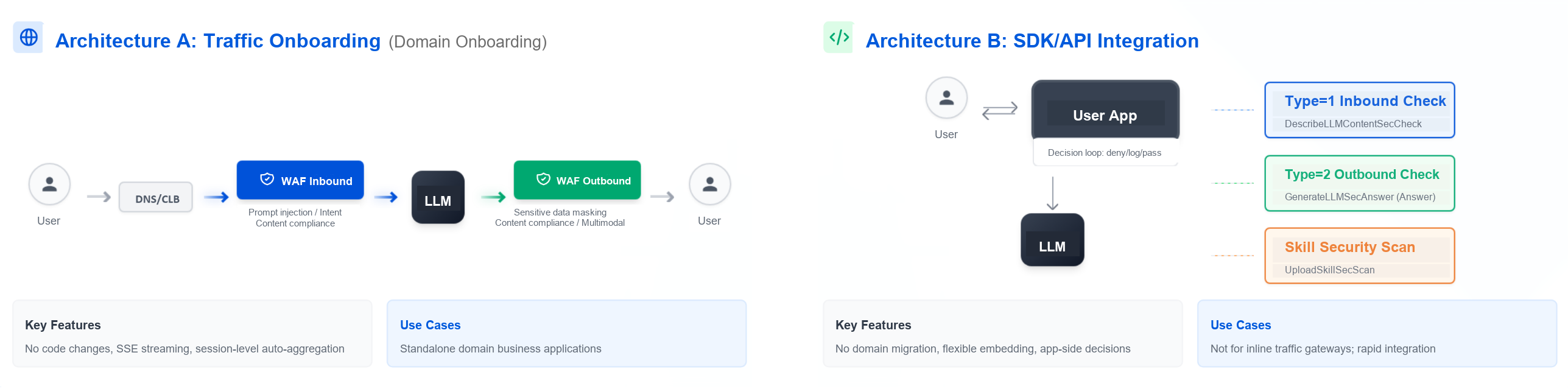
Dimension | Traffic Onboarding (Domain Onboarding) | SDK/API Integration |
Access Mode | CNAME/CLB mounting | Directly call APIs |
Code Changes | No code changes required. | Integrate the SDK and call TencentCloud APIs. |
Domain Migration | Requires DNS/CLB configuration | Not required. |
SSE Streaming Support | Supported | Supported |
Applicable Architecture | Gateway proxy architecture | Flexible embedded architecture |
If your business is deployed on Tencent Cloud and can be connected to WAF in a unified manner, we recommend selecting Traffic Onboarding.
If you use a self-built AI Agent, do not want traffic to pass through WAF, or need multimodal detection and preset detection items for LLM scenarios, we recommend selecting SDK/API Integration.
Activation Method
Yearly/Monthly Subscription
1. Log in to the WAF console, select LLM Security in the left sidebar, and click Enable Now.
2. In the activation dialog, select a plan type and click Enable Now.
Pay-As-You-Go Billing
The pay-as-you-go billing mode supports only SDK/API access. Usage is metered hourly and billed daily on a T+1 basis. To enable this mode, contact your account manager through Presales Consultation.
Ajuda e Suporte
Esta página foi útil?
Você também pode entrar em contato com a Equipe de vendas ou Enviar um tíquete em caso de ajuda.
comentários